Following on X should improve the information and relationships available to the account. A founder might follow customers, practitioners and industry sources. A publication might follow reliable reporters and specialists. Those choices are useful even when they do not produce an immediate follow-back.
The modern follow and unfollow question is therefore one of purpose and method. Build a network you have a reason to maintain, distinguish genuine curation from prohibited churn and understand the limits of any tool before using it to change public relationships.
Replace a ratio target with a network purpose
Write down the account’s role and the kinds of voices it needs to hear. A customer-support account, a technical founder and a local event organizer may need different networks. A single public follower-to-following ratio does not describe those needs.
Define several useful relationship categories: customers who want a public connection, existing partners, relevant practitioners, reliable news sources and community organizations. The categories help the operator make considered decisions instead of selecting people only because they follow a competitor.
Keep a reason for important relationships. “Partner in the annual workshop” or “publishes reliable accessibility research” provides context that a later reviewer can understand. A number in a profile field rarely gives the same information.
Do not assume reciprocity is the objective. A valuable source can remain useful without following the business. Someone who follows back may still have no interest in the offer. Treat the relationship as a choice about context and communication rather than a token exchanged for a metric.
Understand what X prohibits
X’s authenticity policy addresses follow churn, indiscriminate following and attempts to inflate prominence. Following and then unfollowing large numbers to grow a follower count is not made acceptable by changing the intervals between actions.
X’s automation rules also distinguish allowed activity from prohibited methods, including non-API scripting of the website. Product capability and platform permission are separate questions. Use a permitted native or authorized integration route for the actions you choose to perform.
Technical account limits are not a universal safe operating quota. A limit can describe the maximum the platform may allow technically while additional behavior rules still apply. Do not interpret a published ceiling as a recommendation to approach it.
This boundary changes the strategy. The useful task is maintaining an intentional network, not finding an automated pattern that imitates a person closely enough to avoid notice. Choose relationships because they make sense and use a method the platform supports.
Research people through their work and context
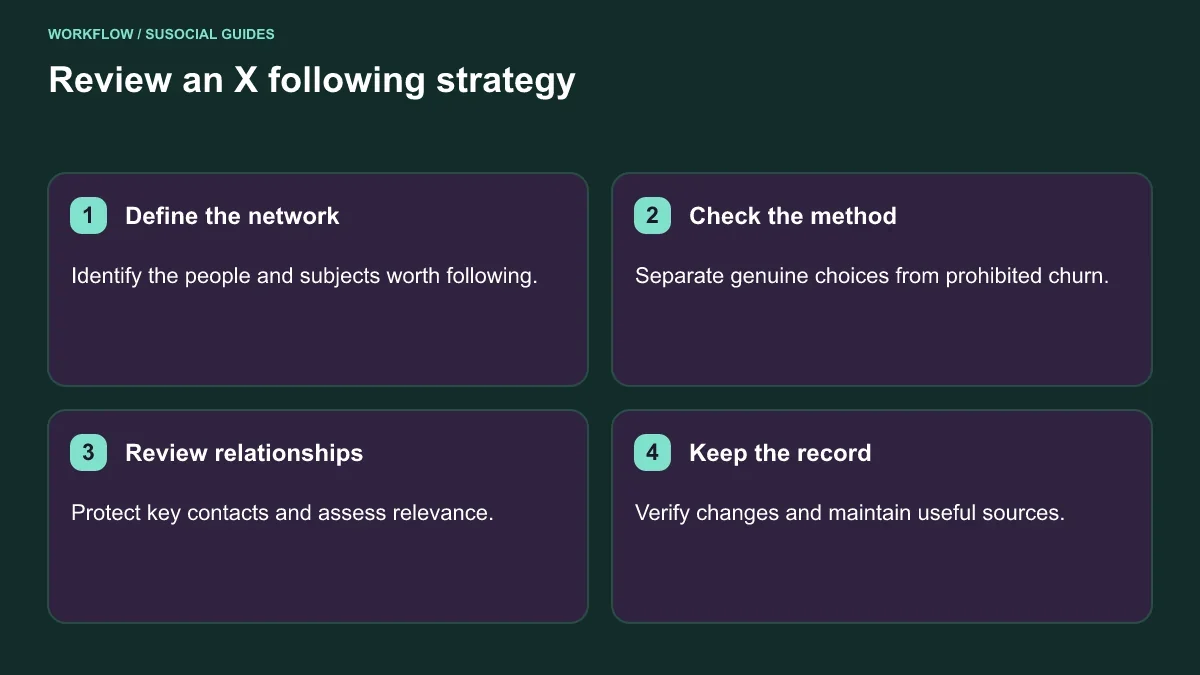
Read recent posts, profile information and relevant source links before deciding whether an account belongs in the network. Look for the subject you need, the quality of the contribution and the relationship to your business purpose.
Use searches to identify conversations and practitioners, but do not turn every matching result into a follow target. A keyword can appear in criticism, a joke or a context unrelated to your offer. The operator should understand the person or source, not merely the word that surfaced it.
Consider a private research list or another organized reading method when you need to monitor a subject without changing a public relationship. Native Lists and other account features should be used according to their current controls and rules. The choice depends on the task, not on a desire to maximize follow activity.
Avoid copying a competitor’s audience as though it were a ready-made lead list. A follower relationship does not establish buying intent or consent to contact. Build your own understanding of the audience through relevant conversations and useful content.
Review the existing network in stages
Start with protected relationships. Identify partners, colleagues, customers and sources whose importance is known. Keep the record private where it includes internal business context. Do not publish personal or sensitive notes in the account itself.
Next, review sources whose relevance is uncertain. An account may have changed subject, stopped serving the business’s needs or become difficult to evaluate. A non-reciprocal relationship alone is not a sufficient reason to remove it.
Separate following from the experience of reading the feed. Muting, list organization or other native controls may address a reading problem without ending a relationship. Verify the current feature behavior before choosing the action.
Make a small, reviewed set of changes and inspect the result. A broad cleanup based on a simplistic filter can remove useful contacts that are hard to reconstruct later. Keep the reason for each consequential decision rather than relying on memory.
Understand SU Social’s documented controls
The Twitter Follow Tool guide describes settings, sources, candidate records and results. It documents controls such as timing, caps and profile-related filters. Understanding those controls is useful when auditing an existing configuration or deciding what should remain disabled.
The Twitter Unfollow Tool guide documents elapsed-time settings, limits, follower-related options and a whitelist. A whitelist can express protected relationships within that tool’s configuration, but an external note does not automatically apply the setting.
Review related after-action options as well. A follow workflow can contain additional behaviors that are separate decisions, such as messaging or liking. Do not assume that a useful relationship choice authorizes every possible follow-up action, and do not enable actions prohibited by current X rules.
Use the documentation to understand the existing workspace, not as proof that every historical capability is approved by the platform today. If the required execution method conflicts with current rules, retain the reviewed plan and perform appropriate actions through a permitted route.
A worked network review for a technical founder
Imagine a founder whose account has accumulated years of follows from conferences, experiments and old projects. The founder now wants the network to support discussions about a specific software field and relationships with existing customers.
The review begins with known collaborators and customers who have a genuine public connection. Those relationships are protected. The editor then identifies useful researchers, maintainers and practitioners whose work the founder actually wants to read.
Some accounts no longer fit the subject, while others are valuable despite never following back. The founder reviews those cases individually. The team does not create a cycle of following strangers and removing them after a short waiting period.
The operator audits the existing tool configuration and disables any unrelated after-actions. Changes that are appropriate are made through a permitted route, with a small record of the decision. The founder then reviews whether the reading and conversation experience has become more useful.
The example demonstrates a network-maintenance process. It does not predict a follower increase, ranking improvement or number of sales conversations.
Keep outreach separate from following
A follow is not consent to receive a sales message. If someone wants a guide or requests help, respond within that context. If the business wants to begin a new conversation, assess whether the contact is welcome and appropriate rather than assuming a public relationship supplies permission.
Keep customer-support routes clear. A person asking about an order or account issue should be directed to the appropriate private channel without exposing personal information publicly. A following strategy should not become an improvised data-collection process.
Use content to give people a reason to connect. Useful explanations, clear product information and thoughtful participation can support a genuine audience. Repeated relationship actions cannot replace that contribution.
Review the Twitter feature overview when planning broader content operations, while checking each task against current platform requirements. Choose the functions that serve the actual communication plan rather than maximizing simultaneous activity.
Evaluate the strategy with useful evidence
Track whether the account can find relevant information, maintain important relationships and participate in suitable conversations. These outcomes align more closely with the network’s purpose than a single ratio.
If you review follower changes, keep the observation separate from causation. A campaign, product launch, news event or useful post can influence who follows the account. Do not attribute every change to a cleanup or a selection rule.
Record unwanted changes and correction effort. A strategy that produces frequent mistakes is not efficient merely because it performs many actions. Use those incidents to simplify the selection policy and improve the protected-contact record.
Keep the review cadence proportionate. A stable network does not need constant churn. Revisit it when the business changes direction, a project ends or the information needs become different.
Use a small decision table during that review. For each uncertain account, record its current subject, the reason it was originally relevant and whether that reason still applies. Mark the proposed action as keep, organize differently or review removal. This gives the owner a concrete decision to approve without exposing private business notes publicly.
Include a category for unknown context. An old relationship may be important to a colleague even when the current operator does not recognize the name. Ask the responsible owner before making a consequential change, and use the answer to improve the register. Uncertainty should lead to clarification rather than an automatic removal rule.
Handle limits and account notices directly
If X displays a restriction or verification requirement, stop the affected activity and follow the official instructions. Do not rotate identities, create replacement accounts or change technical details to evade enforcement. Those responses do not resolve the relationship or method problem.
Keep the notice, affected time and recent approved changes in a private incident record. This helps the account owner understand the issue and decide the next supported step. Avoid declaring a hidden cause without evidence.
Is there a safe daily follow-unfollow number?
No universal number grants permission or guarantees account outcomes. Technical ceilings, behavior rules and the execution method are different considerations. Build the plan around genuine choices and supported routes.
Should non-mutual accounts be removed?
Only when the relationship no longer serves a useful purpose. Reciprocity is one observation, not a complete measure of relevance. A specialist source can be worth keeping even without a follow-back.
What should the strategy deliver?
A network of people and sources the account has a reason to maintain, a clear record of important relationships and a practical review process. That foundation supports better information and communication without relying on follow churn or a promise of algorithmic advantage.


Leave a Reply