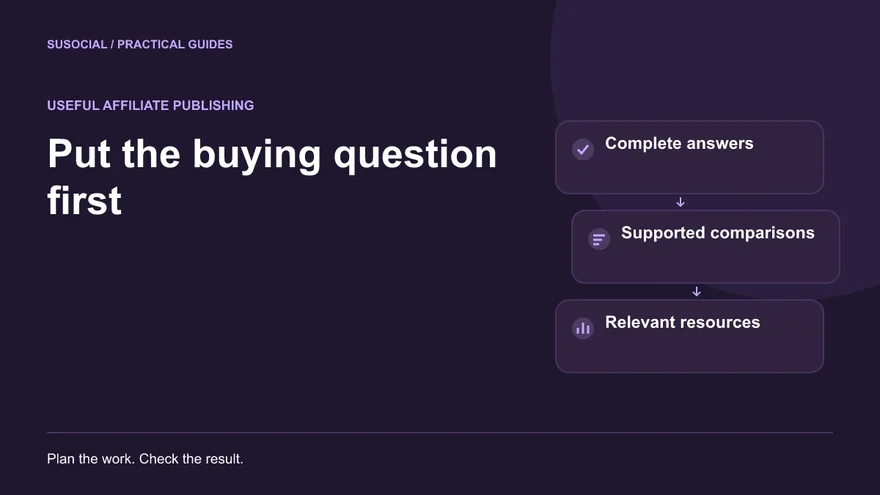
An affiliate publishing business succeeds when readers can make better decisions after using its work. Quora can reveal those decisions in a direct form: someone asks how to compare two options, which constraint matters or whether a product suits a particular task. A useful publisher answers the question before thinking about the next click.
Quora automation for affiliate marketing should therefore begin as an editorial workflow. Research relevant questions, prepare a complete answer and connect it to a genuinely useful resource only where appropriate. Do not build the process around hiding a commercial destination or expecting a fixed amount of traffic from a set number of answers.
Understand the boundary before designing the funnel
Quora’s Question and Answer Policies state that affiliate links are not allowed. They also require answers to address the question, make relevant affiliations explicit and be understandable without leaving Quora. These are important design inputs for a publisher, not details to consider after a link campaign has been prepared.
A separate website can contain its own commercial publishing model, but that does not make a redirect a suitable way to disguise an affiliate link on Quora. Evaluate the answer and the actual destination honestly. A resource should add relevant information and remain useful to the reader, rather than acting as a thin bridge to an offer.
Build the business case around the quality of the explanation and the resources you own. Some useful answers will not need an external link at all. If the only reason to answer is that a commission might be earned after a click, reconsider whether the contribution serves the question.
Choose questions where you can add something specific
Start with a topic you understand well enough to explain beyond a product summary. A publisher covering coffee equipment might know how grind consistency, cleaning effort and available space affect a buying decision. Those criteria can support useful answers even before individual models are mentioned.
Create question groups around tasks and constraints. Examples include choosing a first setup, replacing a specific component, comparing maintenance needs or deciding whether an upgrade is worthwhile. These are different intents and deserve different answers. Repeating one recommendation across all of them is not a meaningful content strategy.
Read the existing answers. Identify what they explain well and what remains unresolved. You may be able to add a clearer decision method, an example calculation or a condition that changes the recommendation. If the question is already answered comprehensively and you have no useful addition, choose another topic rather than rewriting the same points superficially.
Build an evidence pack for the recommendation
For each product category, maintain current official specifications, relevant manuals, known limitations and your own documented observations where you have them. Keep personal testing separate from information gathered from manufacturers. A review should not claim hands-on experience merely because a specification sheet is detailed.
Record the date for facts that change. Product availability, compatibility and plan features can become obsolete. A long-lived Quora answer should emphasise the decision criteria while pointing to current specific information where that information is useful and the link is appropriate.
Use a comparison table privately to prepare the answer:
| Criterion | Question to answer | Evidence to use |
|---|---|---|
| Task fit | What does the buyer need to accomplish? | The question’s stated situation |
| Constraint | What limits the choice? | Budget, space or compatibility actually mentioned |
| Capability | Can the option perform the task? | Current official specification or documented test |
| Effort | What must the buyer maintain or learn? | Manual, procedure or real observation |
| Trade-off | What does the buyer give up? | A supported comparison under stated conditions |
This preparation produces a more useful answer than ranking every product with an unexplained score. The reader needs to understand why a criterion matters, not simply which option the publisher prefers.
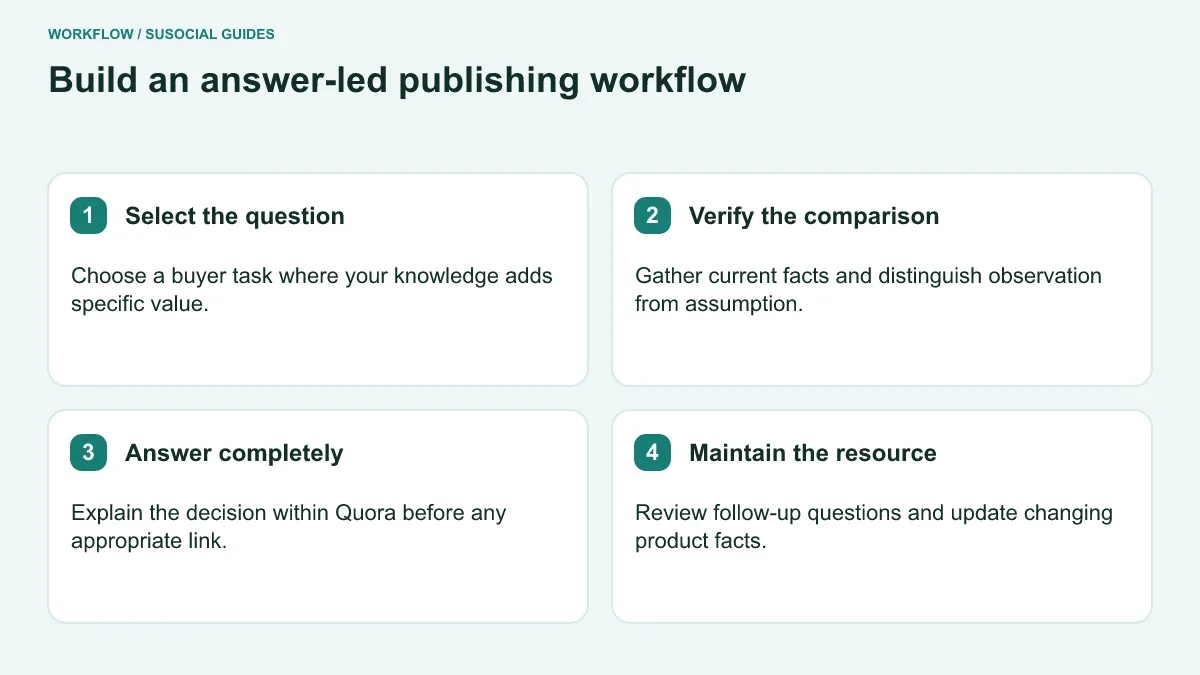
Write a complete answer inside Quora
Open with the conclusion that fits the stated situation. Then explain the relevant criteria and the condition that would change the conclusion. If the question lacks essential context, describe the main cases instead of pretending there is one best choice for everyone.
Use a concrete example. For a coffee grinder, you might explain how a small kitchen and a preference for easy cleaning change the decision compared with a setup used for several brewing methods. The example should clarify the trade-off without claiming an invented customer result.
Include enough detail for the reader to act without visiting your site. A linked guide can provide additional depth, but the answer should not be a teaser that withholds the useful information. Quora’s helpful-answer guidance emphasises clarity, credibility and addressing the actual question.
Keep the commercial relationship understandable where it matters to the recommendation. Avoid presenting a publisher’s selection as an independent personal experience if that is not what it is. A truthful explanation is easier to maintain when readers ask how the recommendation was formed.
Make the supporting resource worth visiting
If a relevant external resource is appropriate, choose a specific page that adds something useful: a detailed method, a compatibility checklist or a documented comparison. A generic homepage or an empty link hub gives the reader another search task instead of continuing the answer.
Inspect the destination as a visitor. Does it answer the promised question on mobile? Are the assumptions and commercial relationships understandable? Can the reader see the information without an unexpected sequence of redirects or an unrelated signup barrier?
Maintain the resource over time. When a product changes, update the comparison and review any answer that depends on the old fact. The value of a publishing business comes partly from keeping its explanations dependable, not simply increasing the number of pages that contain a buying keyword.
Organise discovery and reviewed publishing in SuSocial
SuSocial’s Quora Answers tool guide describes extracting questions by keywords, using negative keywords, selecting questions and preparing answers. Use that workflow to build a reviewed queue rather than assuming every extracted question deserves the same recommendation.
Open the question and its existing answers before drafting. In the Use Questions stage, associate the prepared answer with the exact question it resolves. Keep the author identity, relevant credential and editorial status in your working record so the final contribution is coherent.
The documented answer controls include operating settings and a results view. Configure them for the actual approved workload, then inspect the published answer. Keep the Windows workspace available when the task is expected to run. Software can reduce repeated administration, while the recommendation still needs factual and contextual review.
The Quora features overview provides a wider view of the supported product functions. Use the relevant tools to support a useful answer library, rather than treating account activity or coordinated votes as a substitute for a strong explanation.
A worked example: a compact coffee setup
Imagine a publisher specialising in home coffee equipment. A Quora question asks how to choose equipment for a small kitchen when the reader mainly makes one cup at a time. The publisher identifies three real constraints: counter space, cleaning effort and the brewing method the reader uses.
The answer explains how to compare dimensions, workflow and maintenance. It gives a practical way to measure available space and identify which features are unnecessary for the stated use. It does not claim that one model is universally best or invent years of testing that never happened.
If a supporting resource is appropriate, it points to a detailed space-and-workflow guide rather than an affiliate destination disguised as a neutral link. The essential method remains in the Quora answer. Readers who do not click can still make a better decision.
The publisher records follow-up questions and uses them to improve the guide. If several readers are confused about storage clearance rather than the appliance’s footprint, that becomes a specific correction. The process creates value through better information, without relying on an unsupported monthly revenue promise.
Measure useful readership before commercial return
Track which questions produced clear, maintained answers and which resources readers found useful. Where permitted links generate visits, measure engagement with the relevant page and the next meaningful action. Keep those observations separate from votes or answer views.
For the commercial website, use the analytics and affiliate reporting appropriate to that business. A click, a merchant transaction and a confirmed commission are different stages. Returns, attribution rules and approval timing can affect what becomes realised revenue, so label provisional values clearly.
Do not infer that every later commission was caused by one Quora answer. A reader may encounter several resources or return through another route. Use consistent campaign records where appropriate, and keep the internal analysis honest about what the available data can establish.
Run a short editorial check before release
Ask a reviewer to read the question and the proposed answer together. They should be able to identify the direct answer, the evidence supporting the comparison and the situation in which the recommendation changes. If any of those elements is missing, revise the explanation before it enters the publishing queue.
Then inspect the commercial influence on the selection. Would the answer still recommend the same criteria if a different option paid more commission? Does it explain a reasonable alternative that earns nothing for the publisher? These questions help reveal a comparison shaped primarily by the offer rather than the reader’s task.
Finally, check the links and author description. Remove unsupported experience claims and destinations that do not add the promised information. Keep a record of the approved version so a later product update can be traced to the answers affected by it.
Can a profile link make an unsuitable answer acceptable?
No. The answer still needs to address the question and follow the applicable rules. A profile should help readers understand the author, not serve as a device for concealing the purpose of a repetitive promotion.
Should every answer recommend a product?
No. Some readers need a method, a definition or a reason to postpone a purchase. Helping them reach that conclusion can be a useful contribution. A publisher’s credibility is stronger when the recommendation follows the task rather than the commission opportunity.
What is the best way to scale the workflow?
Improve the evidence library, question selection and review process before increasing publishing volume. Distinct, well-supported answers create a more useful body of work than repeated variations of one sales message. Let the content’s quality and relevance determine the pace.



Leave a Reply